
Crusher machine costs vary by material, capacity, fineness, cleaning standard, safety design, and configuration. Basic food powder crushers may cost a few thousand dollars, while GMP pharmaceutical systems with feeding, screening, dust collection, and automation can cost much more.
For food, chemical, and pharmaceutical production, buyers should view the crusher as part of a complete powder processing system. Reference prices often range from about US$2,000 to US$25,000 per set, depending on requirements.
Typical Crusher Machine Price Range
| Crusher Machine Type | Common Capacity Range | Output Fineness Range | Typical Price Range | Suitable Industries |
| Small powder crusher | 10–100 kg/h | 20–120 mesh | US$1,000–5,000 | Food, lab, small batch |
| Universal crusher | 100–1,000 kg/h | 2–120 mesh | US$3,000–25,000 | Food, chemical, pharma |
| Coarse crusher | 100–2,000 kg/h | 5–30 mm | US$3,000–15,000 | Food, chemical, pharma |
| Hammer mill crusher | 100–3,000 kg/h | 10–100 mesh | US$5,000–30,000 | Food, feed, chemical |
| Pin mill / fine crusher | 50–1,000 kg/h | 40–200 mesh | US$8,000–40,000 | Food, pharma, fine chemical |
| GMP crushing system | 50–800 kg/h | Custom | US$15,000–80,000+ | Pharmaceutical, high-grade food |
| Crusher with dust collector and conveyor | 100–1,500 kg/h | Custom | US$20,000–100,000+ | Powder production line |
The final cost depends heavily on whether the buyer needs only a standalone crusher machine or a complete crushing system. A standalone unit may include only the main crushing chamber, motor, screen, and discharge outlet. A full system may include screw feeding, vacuum conveying, cyclone separation, dust collection, vibration screening, automatic control, and closed transfer.
Main Factors That Affect Crusher Machine Cost
Material of Construction
Material is one of the most important price factors. For food, chemical, and pharmaceutical use, carbon steel is usually not enough for product-contact parts. Most buyers choose SUS304 stainless steel, while corrosive, acidic, or high-purity materials often require SUS316L stainless steel.
For food-contact equipment, surfaces need to be corrosion-resistant, non-toxic, cleanable, and suitable for the processing environment. FDA food equipment guidelines also require food-contact surfaces to safeguard food from infection.
Common material options include:
- Carbon steel:Lower cost, suitable for non-food and non-corrosive materials.
- SUS304 stainless steel:Common choice for food, chemical, and general pharmaceutical materials.
- SUS316L stainless steel:Higher cost, better corrosion resistance, preferred for stricter pharmaceutical or corrosive chemical processing.
- Mirror-polished stainless steel:Higher finishing cost, easier cleaning, better for high-hygiene production.
- Contact-part stainless steel only:Cost-saving option when full stainless steel is not required.
In many projects, the difference between 304 and 316L can increase the machine cost by 10%–30%, depending on thickness, machine size, welding volume, and surface finish.
Capacity Requirement
A crusher machine with higher capacity needs a stronger motor, larger crushing chamber, heavier rotor, stronger frame, larger discharge system, and better dust control. This increases both machine cost and power consumption.
| Capacity Level | Typical Capacity | Machine Cost Impact | Buyer Focus |
| Small batch | 10–100 kg/h | Low | Testing, small production |
| Medium production | 100–500 kg/h | Medium | Stable output, easy cleaning |
| Industrial production | 500–1,500 kg/h | High | Continuous feeding, dust control |
| Large production line | 1,500 kg/h+ | Very high | Automation, safety, full system integration |
A low-capacity crusher may be enough for herbs, spices, sugar, salt, tablets, crystals, or small-batch chemical powders. For continuous production, the buyer should also check feeding speed, discharge efficiency, motor load, screen wear, and temperature rise.
Size and Fineness of Output
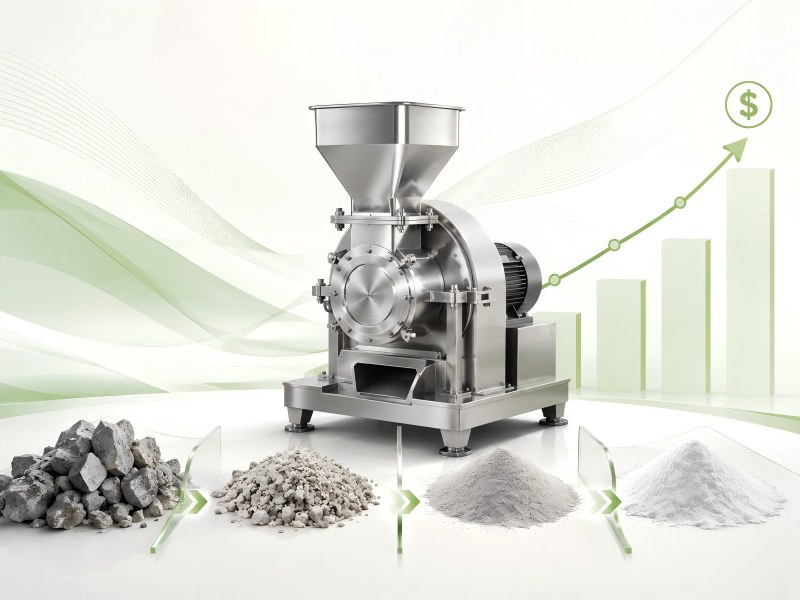
The cost increases as the necessary particle size decreases. Coarse crushing is easier and cheaper because the machine only needs to reduce large materials into smaller pieces. Fine crushing requires higher rotor speed, tighter clearance, better screen design, improved airflow, and sometimes cooling.
Current crusher listings show that universal crushers may cover wide fineness ranges such as 2–120 mesh, while some food powder machines can connect with conveyors, sifters, and mixers for more complete processing.
| Output Requirement | Example Output Size | Suitable Machine | Cost Level |
| Coarse granules | 5–30 mm | Coarse crusher | Low to medium |
| General powder | 20–80 mesh | Universal crusher | Medium |
| Fine powder | 80–200 mesh | Pin mill / fine crusher | Medium to high |
| Ultra-fine powder | 200 mesh+ | Air classifier mill / special system | High |
| Uniform controlled powder | Custom mesh | Crusher + sifter | High |
For food ingredients, powder uniformity affects mixing, dissolving, drying, and packaging. For pharmaceutical materials, particle size can affect flowability, blending uniformity, and downstream processing. For chemicals, fineness may affect reaction speed, dispersion, or final product performance.
Crusher Machine Cost by Industry
Different industries have different buying priorities. The same crusher structure may need different upgrades when used for food, chemical, or pharmaceutical materials.
| Industry | Main Cost Drivers | Common Machine Requirements | Typical Budget Level |
| Food | Hygiene, cleaning, food-contact material, dust control | SUS304, easy cleaning, sealed discharge | Medium |
| Chemical | Corrosion resistance, dust safety, material hardness | SUS304/SUS316L, explosion-proof options, wear resistance | Medium to high |
| Pharmaceutical | GMP design, validation, polishing, containment | SUS316L, cleanable design, low residue, documentation | High |
| Nutraceutical | Hygiene, fine powder, batch changeover | Stainless steel, dust collector, easy disassembly | Medium to high |
| Herbal processing | Fibrous material handling, screen change, cooling | Coarse + fine crushing, dust control | Medium |
Food Industry Crusher Machine Cost
Food crusher machines are used for sugar, salt, spices, grains, dried vegetables, herbs, starch, tea, nuts, seasonings, and food additives. The cost is mainly influenced by hygiene design, stainless steel material, cleaning convenience, and powder control.
Food buyers usually care about:
- Product-contact stainless steel
- Smooth internal surface
- Easy disassembly
- Low material residue
- Stable powder size
- Dust collection
- Low heat generation
- Simple screen replacement
A basic food crusher may cost US$2,000–8,000, while a complete food powder crushing system with feeder, cyclone separator, dust collector, and control cabinet may reach US$15,000–60,000+. Sugar, starch, flour, milk powder, and seasoning dust can also raise safety requirements because many fine organic powders may create combustible dust risks when suspended in air. OSHA notes that dust processing and collection equipment with explosion hazards should include proper prevention or protection measures.
Chemical Industry Crusher Machine Cost
Chemical crusher machines process pigments, resin, fertilizer, catalysts, salts, minerals, crystals, additives, and other dry materials. Compared with food processing, chemical crushing often requires stronger wear resistance and corrosion resistance.
Chemical crusher cost is affected by:
- Material hardness
- Material corrosiveness
- Moisture content
- Dust explosibility
- Required fineness
- Feeding method
- Cleaning frequency
- Explosion-proof motor requirement
For non-corrosive dry chemicals, SUS304 may be enough. For acidic, alkaline, or high-purity materials, SUS316L or special lining may be needed. If the powder is combustible or generates static electricity, the system may require grounding, anti-static design, explosion-proof electrical parts, pressure relief, or inert gas protection.
A standalone chemical crusher may cost US$5,000–25,000, while a safer enclosed crushing system can cost US$30,000–100,000+.
Pharmaceutical Crusher Machine Cost
Pharmaceutical crusher machines are usually more expensive because they require stricter cleaning, material control, documentation, and contamination prevention. FDA guidance for drug manufacturing equipment states that equipment should be properly designed for intended use, cleaning, and maintenance, and product-contact surfaces should not be reactive, additive, or absorptive in a way that affects drug quality.
Pharmaceutical buyers often need:
- SUS316L product-contact parts
- GMP-compliant structure
- Smooth internal surface
- Low dead corners
- Easy disassembly
- Batch traceability
- Dust-free operation
- Closed transfer
- IQ/OQ/PQ documentation support
- Validation-friendly design
For simple pharmaceutical crushing, a stainless steel pulverizer may cost around US$3,000–9,000, based on current supplier listings. However, a complete GMP crushing system with dust collection, vacuum feeding, containment, polished surfaces, and validation documents may cost much more.
Cost Breakdown of a Crusher Machine
| Cost Item | Approximate Share of Total Cost | What It Includes |
| Main crusher body | 35%–50% | Frame, chamber, rotor, screen, blades |
| Motor and transmission | 10%–20% | Motor, belt, bearing, gearbox if needed |
| Stainless steel material | 10%–25% | 304/316L material, thickness, polishing |
| Dust collection system | 10%–30% | Cyclone, filter, pulse dust collector |
| Feeding and discharge | 5%–20% | Hopper, screw feeder, vacuum conveyor |
| Electrical control | 5%–15% | Control box, inverter, safety switches |
| Custom design | 5%–20% | Special layout, GMP design, explosion-proof options |
| Testing and documentation | 3%–10% | FAT, manuals, validation documents |
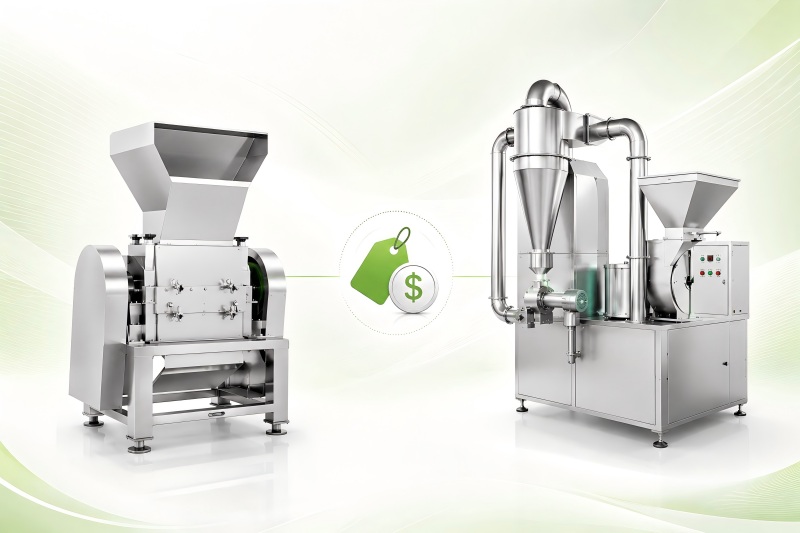
These percentages are only a practical reference. For a simple crusher, the main machine body takes the largest share. For a pharmaceutical or chemical system, dust control, automation, safety, and documentation can become a much larger part of the total investment.
Standalone Crusher vs Complete Crushing System
| Configuration | Lower Cost | Higher Cost | Best For |
| Standalone crusher | Yes | No | Small batch, simple materials |
| Crusher + dust collector | Medium | Medium | Food powder, chemical powder |
| Crusher + conveyor + sifter | Medium | High | Continuous powder production |
| GMP closed crushing system | No | High | Pharmaceutical materials |
| Explosion-proof crushing line | No | Very high | Combustible or hazardous powders |
A standalone crusher may look cheaper at first, but it may create hidden costs if the factory later needs dust collection, feeding equipment, screening, or cleaner discharge. For powder production, the system around the crusher is often as important as the crusher itself.
Hidden Costs Buyers Should Include
Many buyers only compare the machine price, but the real project cost also includes installation, spare parts, cleaning time, power use, downtime, and maintenance.
Important hidden costs include:
- Freight and export packing
- Import duty and local tax
- Installation and commissioning
- Electrical wiring and air supply
- Spare blades, screens, and bearings
- Dust filter replacement
- Cleaning labor
- Operator training
- Production downtime
- Validation documents for pharma use
- Safety upgrades for combustible dust
- Future connection with dryers, mixers, or granulators
A cheaper crusher machine may become more expensive if it wears quickly, creates too much dust, overheats materials, requires long cleaning time, or cannot keep particle size stable.
How Capacity Changes the Real Cost
For industrial buyers, the cost should be compared by output, not only by machine price.
Example calculation:
| Machine Option | Machine Price | Capacity | 8-Hour Output | Cost per kg Daily Capacity |
| Small crusher | US$4,000 | 80 kg/h | 640 kg/day | US$6.25 |
| Medium crusher | US$12,000 | 300 kg/h | 2,400 kg/day | US$5.00 |
| Large crusher | US$35,000 | 1,000 kg/h | 8,000 kg/day | US$4.38 |
A larger crusher costs more at purchase, but it may reduce cost per kg if the factory has enough production demand. However, oversizing is also risky. If the production volume is low, a large crusher may waste power, space, and budget.
How to Select an Economical Crusher Device
The cheapest crusher isn’t usually the most economical one. The best choice should match the material, target fineness, hygiene level, and production capacity.
Before requesting a quotation, buyers should confirm:
- Raw material name and characteristics
- Initial material size
- Target output size or mesh
- Required capacity per hour
- Moisture content
- Oil content or stickiness
- Heat sensitivity
- Material hardness
- Cleaning frequency
- Industry standard: food, chemical, or pharmaceutical
- Need for dust collection
- Need for conveyor, sifter, mixer, or dryer connection
- Voltage and factory layout
- Budget range
- Certificates and necessary paperwork
This information helps the manufacturer select the proper crusher type instead of quoting a machine that is too small, too large, or unsuitable for the material.
Practical Buying Recommendations
For food factories, choose a stainless steel crusher with easy cleaning, smooth contact surfaces, and dust collection. It is better to spend more on hygiene and stable output than to save money on a machine that leaves residue inside the chamber.
For chemical plants, focus on material compatibility, wear resistance, dust safety, and explosion-proof design when needed. Chemical powders can be abrasive, corrosive, or hazardous, so the lowest machine price may not be the safest option.
For pharmaceutical production, cost should be evaluated together with GMP design, cleaning validation, documentation, and containment. A standard stainless steel crusher may work for simple materials, but regulated production usually needs a more controlled system.
Crusher machine costs range from a few thousand dollars for a basic stainless steel crusher to tens of thousands for a complete powder processing system. Price depends on capacity, material, fineness, dust control, automation, safety, and cleaning needs.
Simple crushing may only need a standalone crusher, while stable powder production often requires feeding, screening, dust collection, and discharge systems. For food and pharmaceutical use, GMP design, cleanability, and documentation are especially important.