
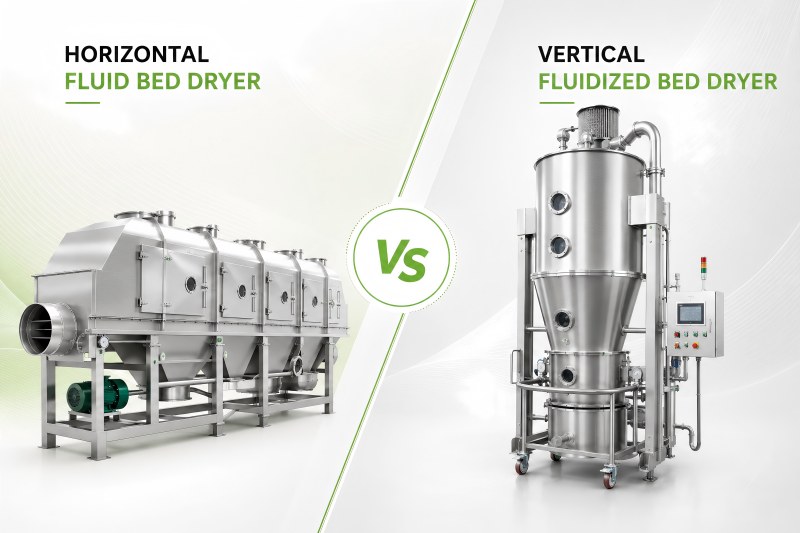
Horizontal and vertical fluid bed dryers both use hot air to dry particles, but they differ in structure, capacity, cleaning, and suitable applications.
Horizontal fluid bed dryers are better for continuous, large-capacity drying, while vertical fluidized bed dryers are more suitable for batch drying, granulation drying, and compact GMP production.
The best choice depends on material properties, moisture target, hygiene needs, layout, and budget.
What Is a Horizontal Fluid Bed Dryer?
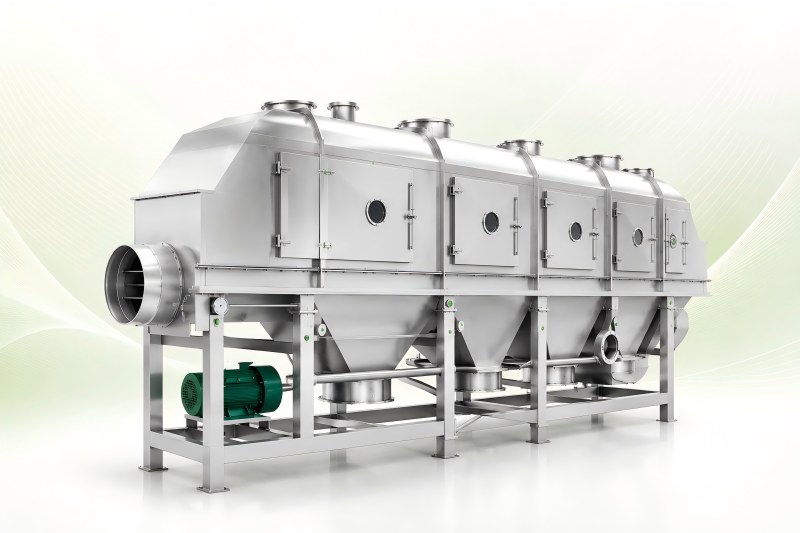
A horizontal fluid bed dryer usually has a long rectangular drying chamber. Wet particles enter from one side, move along the bed, and discharge from the other side after drying. Hot air passes through the perforated plate from the bottom and fluidizes the material layer.
Many horizontal models are designed as continuous fluid bed dryers or vibrating fluid bed dryers. Vibration helps move particles forward and improves fluidization, especially for materials that are slightly sticky, irregular, or difficult to flow.
Horizontal fluid bed dryers are commonly used for:
- Food granules
- Sugar and salt
- Starch and grains
- Fertilizer granules
- Chemical crystals
- Resin particles
- Plastic pellets
- Mineral particles
- Agricultural materials
In industrial design references, continuous fluid bed dryers may handle from tens of kilograms per hour to several thousand kilograms per hour, while heavy-duty mineral dryers can reach much higher capacity. One technical guide lists continuous fluidized bed dryer throughput at about 50–5,000 kg/h, with inlet air temperature often around 60–200°C and residence time around 1–10 minutes depending on the process design. TEMA Process also notes that large continuous fluid bed dryers can be used for high-volume materials such as sand, gravel, clay, and limestone, with capacities up to 200 t/h in heavy industrial applications.
What Is a Vertical Fluidized Bed Dryer?
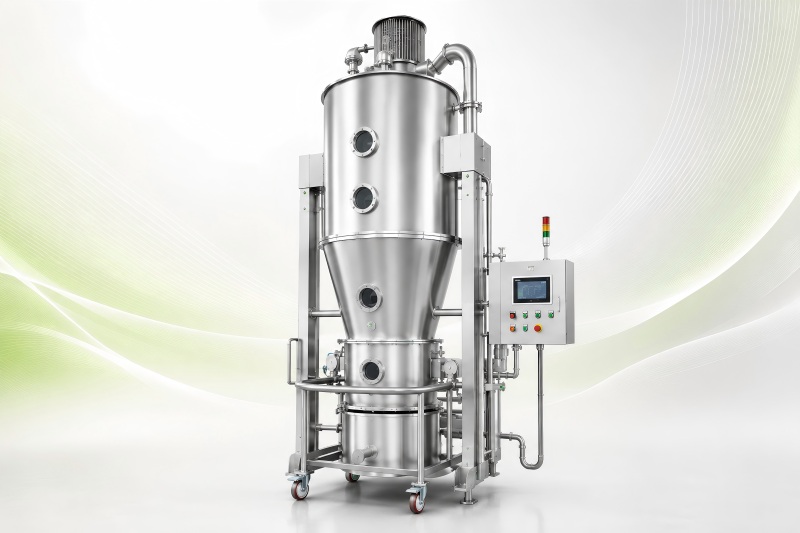
A vertical fluidized bed dryer usually has a vertical cylindrical or conical chamber. The material is loaded into a product bowl or container, and hot air flows upward from the bottom to fluidize the wet granules or particles. After drying, the batch is discharged, and the next batch begins.
This type is very common in pharmaceutical, food, nutraceutical, and fine chemical production. Instead of quoting a machine that is too big, too small, or inappropriate for the material, the manufacturer can use this information to choose the appropriate type of crusher.
Vertical fluidized bed dryers are commonly used for:
- Pharmaceutical granules
- Tablet granulation drying
- Food powder granules
- Instant drink granules
- Herbal extract granules
- Chemical powder granules
- Nutraceutical products
- Small to medium batch production
A pharmaceutical fluidized bed granulator/dryer example from Truking Feiyun lists batch capacities from 40–120 kg/batch for a 200 L model up to 150–500 kg/batch for a 1000 L model, with inlet air temperature control from room temperature to 100°C and filtration options such as M6 + F9 + H13. This shows why vertical fluid bed dryers are often selected for controlled batch production instead of very large continuous drying.
Horizontal vs Vertical Fluidized Bed Dryer: Quick Comparison
| Item | Horizontal Fluid Bed Dryer | Vertical Fluidized Bed Dryer |
| Main structure | Long rectangular chamber | Vertical cylindrical chamber |
| Production mode | Mostly continuous | Mostly batch |
| Material movement | Moves horizontally across bed | Fluidized in one vertical chamber |
| Capacity range | Medium to very large | Small to medium batch |
| Footprint | Longer floor space | Smaller floor area, taller height |
| Drying control | Residence time controlled by bed length, vibration, feed rate | Batch time controlled by temperature, airflow, and loading |
| Cleaning | More internal length, more sections | Easier batch cleaning in many designs |
| Best for | Continuous particles, crystals, granules | Pharmaceutical granules, high-value batches |
| Automation | Strong for production lines | Strong for batch control and recipes |
| Typical industries | Food, chemical, agricultural, mineral | Pharmaceutical, food, nutraceutical, fine chemical |
Key Data Comparison
| Parameter | Horizontal Fluid Bed Dryer | Vertical Fluidized Bed Dryer |
| Typical production style | Continuous | Batch |
| Common capacity reference | 50–5,000 kg/h for many continuous designs | 40–500 kg/batch for many pharma-size models |
| Residence / drying time | Around 1–10 minutes in many continuous systems | Often 20–60+ minutes depending on material |
| Inlet air temperature | Often 60–200°C, material dependent | Room temperature to 100°C in many pharma models |
| Material layer | Shallow and spread out | Deeper batch bed |
| Floor space | Larger | Smaller |
| Product changeover | Medium to slower | Faster for batch products |
| GMP suitability | Possible, but more complex | Very common |
| Line integration | Excellent for continuous lines | Good for batch granulation lines |
These numbers are reference values only. Real drying performance depends on initial moisture, final moisture target, particle size, bulk density, heat sensitivity, airflow, exhaust humidity, and whether the product fluidizes well. Research on fluidized bed dryers also notes that scale-up, poor fluidization, and non-uniform product quality can be difficult, so lab testing and pilot testing are important before final equipment design.
Difference in Working Principle
Both dryers use the same basic fluidization concept. The wet particles are lifted by hot air that travels upward through a perforated plate. When airflow is strong enough, the material behaves like a boiling fluid. This creates good contact between hot air and particle surfaces, improving heat transfer and moisture removal.
The difference is how the material travels.
In a horizontal fluid bed dryer, material moves from inlet to outlet. The dryer may be divided into drying zones and cooling zones. Feed speed, vibration force, bed depth, airflow, and temperature can be adjusted to control residence time.
In a vertical fluidized bed dryer, material remains in one chamber during each batch. The operator loads wet granules, sets drying conditions, and discharges the batch after the moisture reaches the target. The process is easier to connect with batch records, recipe control, and pharmaceutical production management.
Capacity and Production Efficiency
Capacity is one of the strongest reasons to choose a horizontal dryer. For large-volume production, continuous feeding and continuous discharge reduce waiting time between batches. When the manufacturer processes the same product over extended periods of time, this is helpful.
Horizontal fluid bed dryers are better when buyers need:
- High hourly output
- Continuous production
- Stable feed and discharge
- Connection with granulators, extruders, or coolers
- Drying and cooling in one line
- Lower labor per ton of product
Vertical fluidized bed dryers are better when production is batch-based. They are especially useful when different formulas, product grades, or active materials are processed in separate batches.
Vertical fluidized bed dryers are better when buyers need:
- Controlled batch drying
- Small to medium capacity
- Frequent product changeover
- Granulation line matching
- GMP documentation
- Easier sampling and batch release
- Compact installation layout
Footprint and Factory Layout
A horizontal fluid bed dryer needs more floor length. The chamber, feed system, discharge system, air handling unit, exhaust duct, cyclone, filter, and control system may occupy a long production area. This is acceptable in large food or chemical factories, but it may not be ideal for compact GMP workshops.
A vertical fluidized bed dryer requires less floor area but more vertical height. It is easier to place in a pharmaceutical granulation room, especially when the process includes high-shear mixer, wet granulator, fluid bed dryer, milling machine, blender, and tablet press.
| Layout Factor | Horizontal Dryer | Vertical Dryer |
| Floor length | High | Low |
| Building height | Medium | Medium to high |
| Easy line connection | Strong | Strong in batch lines |
| Workshop flexibility | Lower | Higher |
| Best layout | Continuous production area | GMP batch room |
Cleaning and Product Changeover
Cleaning is a major cost factor in food, chemical, and pharmaceutical production. A dryer that looks efficient during operation may create high labor cost if cleaning takes too long.
Horizontal fluid bed dryers have longer chambers and more internal zones. Cleaning may take more time, especially when the material is sticky, oily, colored, or allergenic. For single-product or low-changeover production, this is not a major problem. For multi-product production, cleaning design must be checked carefully.
Vertical fluidized bed dryers are often easier for batch cleaning because the product container, filter chamber, expansion chamber, and spray components can be designed for access and inspection. In pharmaceutical applications, this structure is more familiar for GMP cleaning validation.
Product Quality and Moisture Uniformity
Both dryer types can produce good moisture uniformity when designed correctly. The risk comes from poor fluidization.
Poor fluidization may cause:
- Wet spots
- Agglomeration
- Uneven final moisture
- Channeling airflow
- Product overheating
- High dust loss
- Particle breakage
- Lower yield
Horizontal dryers provide a shallow bed and longer travel path, which can help with uniform drying in continuous production. Vertical dryers provide strong batch mixing and are easier to monitor as one controlled batch.
For heat-sensitive materials, temperature control is critical. Studies on fluid bed dryer energy optimization note that higher inlet air temperature and airflow can shorten drying time in theory, but real performance depends on product type and process conditions. General Kinematics also points out that overly high inlet air temperature can form a surface crust on granules, delaying internal moisture migration instead of improving drying.
Cost Comparison
Horizontal fluid bed dryers are usually more expensive when the system is designed for continuous production because they require a longer chamber, larger air handling system, vibration system, feeding device, discharge device, dust collection, and sometimes cooling sections.
Vertical fluidized bed dryers may have a lower equipment footprint, but GMP-grade designs can still be expensive because of stainless steel quality, filtration, polishing, explosion-proof options, containment, automation, and validation documents.
| Cost Item | Horizontal Fluid Bed Dryer | Vertical Fluidized Bed Dryer |
| Main machine cost | Medium to high | Medium |
| Air handling system | High | Medium |
| Installation space | High | Low to medium |
| Automation | Medium to high | Medium to high |
| Cleaning cost | Medium to high | Medium |
| GMP cost | High if required | Common and mature |
| Cost per kg in large production | Often lower | Higher for large continuous output |
| Best value point | Long-run production | High-control batch production |
Application Comparison by Industry
Food Industry
For sugar, salt, starch, grains, and food granules, horizontal fluid bed dryers are often suitable because these products may require continuous, stable, high-capacity drying. If the factory runs one product for long production periods, a horizontal dryer can improve efficiency.
Vertical fluidized bed dryers are more suitable for food ingredients with batch control needs, such as instant drink granules, nutrition powder granules, seasoning granules, and premium functional food products.
Chemical Industry
Chemical plants often choose horizontal fluid bed dryers for crystals, resin particles, fertilizer granules, catalysts, and plastic pellets. These materials often need continuous production and stable throughput.
Vertical fluidized bed dryers are used for fine chemicals, small-batch specialty powders, and products that require careful batch separation. If the material is hazardous, dusty, or solvent-related, explosion-proof design and dust containment become important.
Pharmaceutical Industry
Vertical fluidized bed dryers are more common in pharmaceutical granulation because batch records, containment, filtration, cleaning validation, and recipe control are easier to manage. The vertical design also fits well with wet granulation and tablet production.
Horizontal dryers can be used in pharmaceutical production, but they are more suitable for specific continuous manufacturing lines or large-scale granule drying projects.
Selection Guide
Choose a horizontal fluid bed dryer if your project needs:
- Continuous drying
- Large hourly capacity
- Long production runs
- Drying and cooling in one line
- Stable granules, crystals, or pellets
- Lower cost per kg at high output
- Integration with upstream and downstream equipment
Choose a vertical fluidized bed dryer if your project needs:
- Batch drying
- GMP production
- Compact layout
- Frequent formula changes
- Granulation drying
- Better batch traceability
- Easier cleaning validation
- Small to medium production volume
Horizontal and vertical fluid bed dryers use the same air-fluidization principle but suit different production needs. Horizontal fluid bed dryers are better for continuous drying, high output, and large-volume food or chemical production. Vertical fluidized bed dryers are better for batch drying, pharmaceutical granules, compact GMP workshops, and frequent product changeover.
Key selection factors include capacity, material behavior, final moisture target, cleaning needs, factory layout, and continuous or batch operation. Horizontal dryers offer higher throughput, while vertical dryers provide better flexibility and easier quality control.